
Category Profiling – The Foundation of Strategic Procurement

By: Ramzi Ibrahim, FCIPS
www.procumart.com
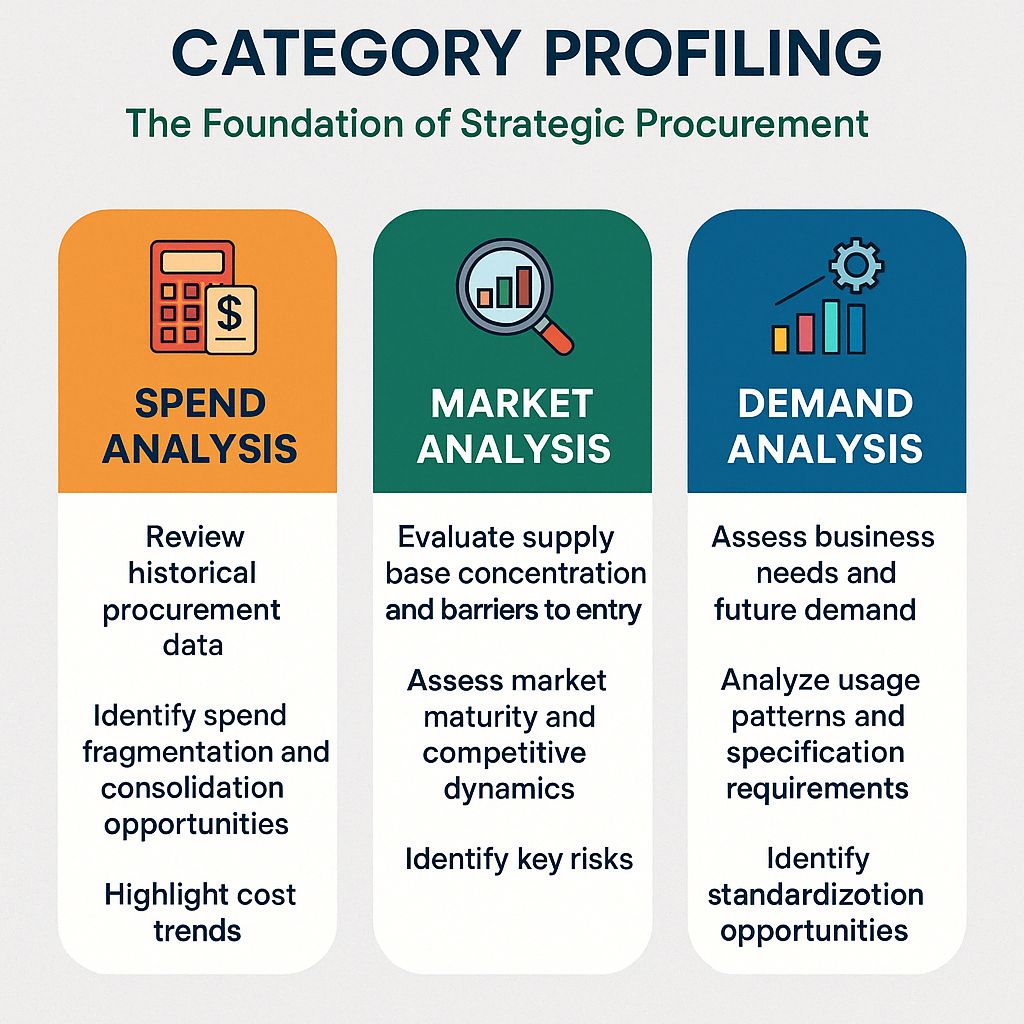
Category Profiling by Procumart

The first and arguably most critical step in successful category management is profiling your category. Before jumping into strategy formulation or market engagement, it’s essential to build a detailed understanding of the category’s internal dynamics and external environment. This is achieved through a combination of spend analysis, market analysis, and demand analysis—each providing a unique lens into the category’s strategic importance and opportunities.

1. Spend Analysis

This involves reviewing historical procurement data to understand what is being bought, from whom, how much is being spent, and how often. Through this lens, you can identify fragmentation in spend, opportunities for consolidation, and potential compliance issues with existing procurement policies. It also highlights cost trends, helping you to prioritize high-value or high-risk areas within the category.

2. Market Analysis

Understanding the external supply market is crucial. This includes evaluating supply base concentration, barriers to entry, market maturity, competitive dynamics, and key risks (e.g., geopolitical, economic, technological). A robust market analysis allows you to assess supplier power, leverage sourcing opportunities, and mitigate external threats.

3. Demand Analysis

This is where internal stakeholder engagement becomes vital. Demand analysis assesses business needs, future demand projections, usage patterns, and specification requirements across departments. It often reveals opportunities to standardize specifications, challenge demand assumptions, or drive demand management initiatives—all critical for aligning procurement strategies with organizational goals.


In Conclusion
Category profiling is more than a data exercise; it’s a strategic enabler. By combining insights from spend, market, and demand analysis, procurement professionals can tailor category strategies that reduce cost, minimize risk, and deliver long-term value.

Procurement’s Tools of Analysis

As procurement becomes a more strategic and adding value functions , it is essential for procurement professionals to use different strategic tools as part of their market analysis effort, as long as these tools fit to the purpose of the 5Ps of procurement  function.

Some of these tools are: 

1) Porter’s five forces – the tool’s original purpose is to provide an analysis of an organisation competitive macro environment. From organisational strategic perspective, firms use this tool to establish high barriers of entry and substitution to a achieve monopoly situation and establish sustainable competitive advantage. However, from buyer’s point of view the tool should be used in a way to lower barrier to entry and substitution to create a competitive market, this will help to reduce suppliers bargaining powers, lower the suppliers switching costs and increase buyers’ flexibility. 

2) Kaplan and Norton’s balanced scorecard – is a strategic management tool which balances the financial performance of a firm with customers’ knowledge and satisfaction, internal business processes and learning and growth opportunity. However, in procurement dimension, this should be aimed to measure the contract-specific operational performance by measuring not only the financial operation of the supplier but also the other factors of the model.  

3) Segmentation tools – the Kraljic matrix is the model that is used normally to assess purchases (goods and/or services) according to its strategic importance and the complexity of the supply market. It is used to helps organisations to develop effective category management approaches (e.g. e-procurement and blanket orders for routine and low value items and strategic partnership for strategically important material).

4) STEEPLE – is a common tool used to analyse organisations’s macro environment. STEEPLE tools can be effectively used as one of the Procurement analysis methods as long as is not misused with internal factors. For example, internal IT systems are often described under “technology” and the threat of them failing is often pointed out, whereas the broad technology trend and the risk of not keeping up-to-date is the factor that should be considered under this tool.

Procurement tools of analysis

As procurement becomes a more strategic and adding value functions , it is essential for procurement professionals to use different strategic tools as part of their market analysis effort, as long as these tools fit to the purpose of the 5Ps of procurement  function.

Some of these tools are: 

1) Porter’s five forces – the tool’s original purpose is to provide an analysis of an organisation competitive macro environment. From organisational strategic perspective, firms use this tool to establish high barriers of entry and substitution to a achieve monopoly situation and establish sustainable competitive advantage. However, from buyer’s point of view the tool should be used in a way to lower barrier to entry and substitution to create a competitive market, this will help to reduce suppliers bargaining powers, lower the suppliers switching costs and increase buyers’ flexibility.

2) Kaplan and Norton’s balanced scorecard – is a strategic management tool which balances the financial performance of a firm with customers’ knowledge and satisfaction, internal business processes and learning and growth opportunity. However, in procurement dimension, this should be aimed to measure the contract-specific operational performance by measuring not only the financial operation of the supplier but also the other factors of the model.  

3) Segmentation tools – the Kraljic matrix is the model that is used normally to assess purchases (goods and/or services) according to its strategic importance and the complexity of the supply market. It is used to helps organisations to develop effective category management approaches (e.g. e-procurement and blanket orders for routine and low value items and strategic partnership for strategically important material). 

4) STEEPLE – is a common tool used to analyse organisations’s macro environment. STEEPLE tools can be effectively used as one of the Procurement analysis methods as long as is not misused with internal factors. For example, internal IT systems are often described under “technology” and the threat of them failing is often pointed out, whereas the broad technology trend and the risk of not keeping up-to-date is the factor that should be considered under this tool.

Procurement insight!

Risk Management in the Public Procurement Context

Risk management in relation to procurement services within the public domain can be identified in two dimensions:

1- Procurement Process Risks, for example : Public Authority does not have legal capacity to procure, No allowance made for whole life costs, proper procurement process are not followed in accordance with the Policy, delay or not obtaining appropriate approval; lack of enough or inappropriate budgeting; and conflict with existing contact.

2- Product and/or service Risks, for example : delay in the delivery process, failure of new technologies, incompatibility of the new products with existing systems; product/service doesn’t meet the desired outcomes; and lack of in-house knowledge to develop effective specification or scope of works.

To identify, manage and mitigate these risks, a Risk Management Framework (RMF) should be used; generally consisting of the following steps:

a) Identify what are the key activities in each phase of the procurement process or what are the key features of the products and or services.

b) Identify what are the critical success factors in each phase of the procurement or what are the most important factors in the products / services and identify “what may go wrong” – the Risk.

c) Identify what controls are in place to manage these risks.

d) Assess the level of the risk in terms of Consequences and Likelihood; each organization would have different “Risk Reference Tables” and the level of the risk should be based on that table.

e) Decide whether the level of risk is acceptable, if not put an action to reduce the risk (e.g. indemnity and insurance clause in the contract).

d) Monitor, learn and adapt control as necessary.

Risk management is an integral part of the procurement, commercial and contracting processes and RMF together with risk registers should be used to achieve an effective and sustainable outcomes